
China Discovery Tour: XI’AN
14 March 2026
Arriving at Xi’an airport on a flight from Chongqing, we decided to use public transport to get to our hotel, some 40km away, rather than taking the easier but more expensive Didi solution.
It was straightforward enough to locate the subway station at the arrivals terminal but we could not make ourselves understood to the station staff as to which train we needed to take. Somewhat in desperation, we rang our hotel, the WOW Victory Hotel; their customer representative, Aria, told us in good English what ticket we needed to buy and which train we should take. She even stayed on line to ensure that we made the right connection when changing to another line and lo and behold, she was waiting to welcome us with a big smile when we finally got out of the subway station to escort us to the hotel. In all my years of travel, over 75 countries on 6 continents, that was a first.
Aria upgraded us to a lovely, spacious room with floor-to-ceiling windows and a wonderful view of the 700 years old Xian City Wall. She also gave us tips on what to do and where to eat. For example, she recommended a Food Court nearby, Qinling, were we could order a local speciality, a Xi’an Hamburger/ Rou Jia Mo with cold skin noodles and orange-flavoured soda. It was delicious.
That evening, we strolled along the moat which surrounds the City Wall and ended up at the Bell Tower, built in 1384, and which marked the geographical centre of Xian. We took an immediate liking to Xi’an; the vibe was laid back, people seemed unhurried and there were parks and nature all around us.
Xi’an is one of the birthplaces of the ancient Chinese civilization with over 3,000 years of history, including over 1’100 years and 13 dynasties as the capital city of ancient China. This included the Qin (221-207 BC), the first unified dynasty of China, founded by Emperor Qin Shi Huang. During the Tang Dynasty (618-907), Xi’an was the largest and most prosperous city in the world. No other city in China has so many historical remains. In 1981, UNESCO listed Xi’an as “World Historical City”, on a par with Rome, Athens and Cairo.
We had come to see some of them.
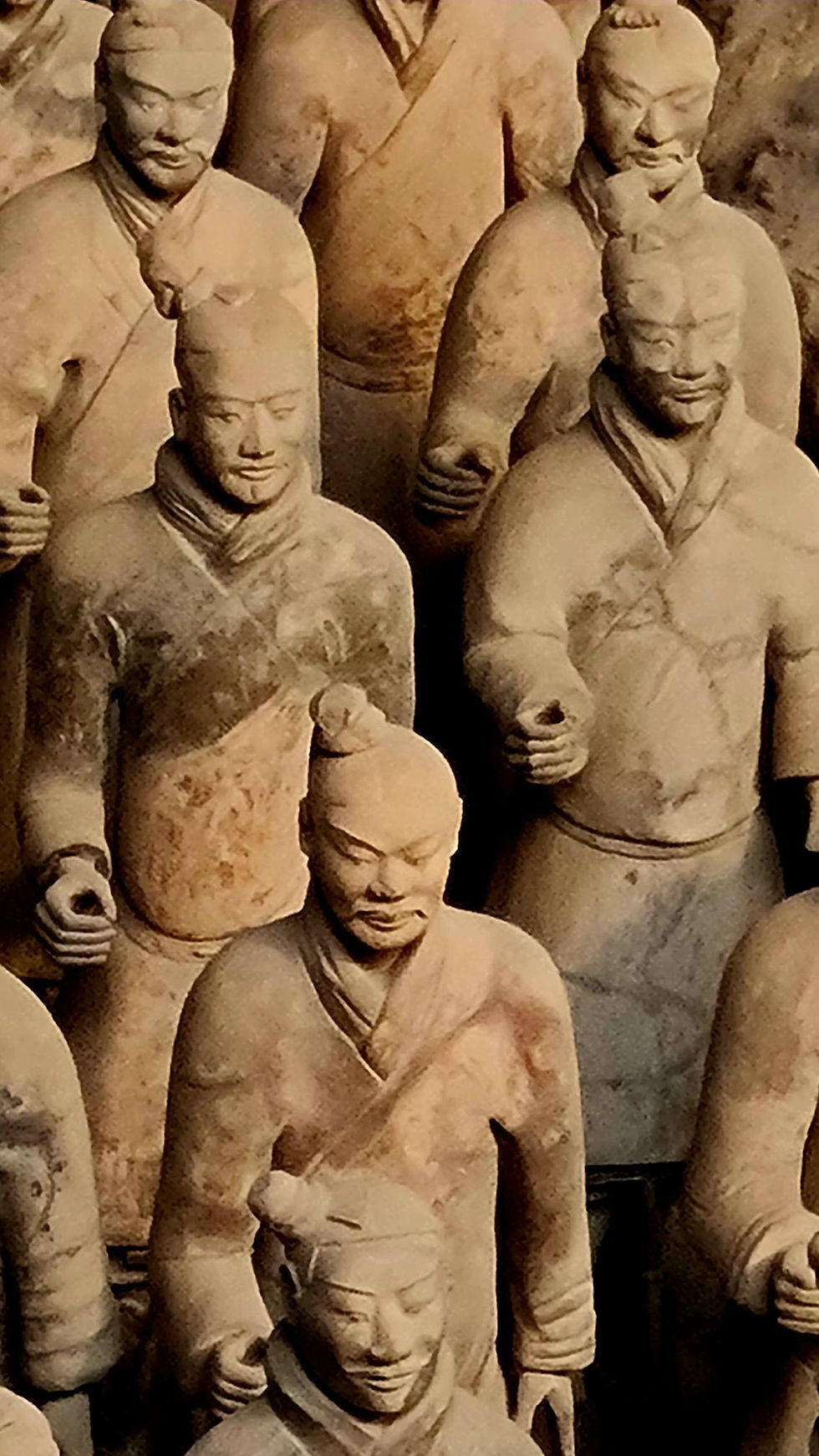
The most famous is without a doubt, the Terracotta Army, consisting of thousands of life-sized terracotta figures, each with a unique expression. Over 2,200 years ago, unified China’s first emperor, Qin Shi Huang, ordered this underground army to be built as his guardians in the afterlife. It can be found at the Emperor’s Mausoleum Sie Museum, about an hour from the city centre. Seeing these figures with their horses lined up in battle formation was a truly memorable experience.
Even more ancient was the Big Wild Goose Pagoda, originating from 652 AD. Built with bricks (rather than timber to avoid the place burning down as it was filled with ancient Buddhist scriptures and relics brought back from India), it is 7 storeys high. The two sides of the square cone taper to a pointed top and we climbed up the twisting staircase to get a panoramic view of the city. On each of the floors ancient relics, books and millennium-old bricks are displayed. There are beautiful squares, gardens and fountains surrounding the pagoda; locals were exercising in the warm spring sunshine, the cherry and peach trees were in full bloom and it was very pleasant just to sit on a bench and watch the world go by.
Xi’an City Wall is the most complete city wall that has survived in China as well as being one of the largest ancient military defensive systems in the world. The wall is 8km long, 12 metres high and 12-14 metres at the top (even wider at the bottom). There are four main gates and every 120 metres is a rampart extending out from the wall itself. On each rampart is a watchtower. The city was never taken by force. Today, along the moat, locals indulge in more peaceful pastimes, such as walking their pets, taking a stroll or practising tai chi. At night the illuminations of the moat and city wall conjure up an enchanting scene.
Located to the north of the Drum Tower is the Muslim Quarter. More than 60’000 Muslims live here around the Great Mosque (dating from 742 AD) and the whole area is bustling with life - souvenir shops, restaurants, street food and food stores. Xi’an was the eastern terminus of the Ancient Silk Road and Muslim people from the Arabian countries travelled here, bringing their wares to trade and sell. Many of them stayed.
On the way to the Muslim Quarter from our hotel, there were many street stalls by the City Wall selling arts and crafts, jewellery and souvenirs and we spent a very relaxing time looking at (and in some cases, even buying) their wares.
On our last night in Xi’an, we went to a fine dining restaurant, again recommended by Aria. There were 8 courses in all with all kinds of meat, fish, soups and vegetables. It was rather overwhelming. We decided that the Qinling Food Court was more to our liking.
It was with a heavy heart that we left our hotel the next morning to take the subway to the airport and our next destination, Shanghai. But we both felt that we would be back here again one day.


Comments