
Yerevan - the pink City
- atricgery
- Jul 29, 2022
- 4 min read
Updated: Aug 2, 2022
22 June 2022
Yerevan, the capital of Armenia, is a 6-7 hour marshrutka (shared minivan) journey from Tbilisi. The scenery en route is beautiful and it would have been great to just sit back and admire the topography. Unfortunately, we could not; our driver was a sour-faced kamikaze who appeared to be tired of living and in desperate need of an anger management course. He took road rage to a new level as he careered around mountain hairpin bends at an inordinate speed, with a very liberal use of his horn, bullying the cars in front of him to get out of his way as if he was delivering an urgently awaited heart for a transplant in Yerevan General Hospital. He remained totally oblivious to his passengers’ pleas to slow down, it just seemed to encourage him to go even faster. We finally arrived in Yerevan, shell-shocked, some 1-2 hours ahead of schedule.
Our first impressions of Armenia were therefore skewed by the actions of this nutter but as we slowly recovered from the nightmare ride, we began to take a proper look at our surroundings and we liked what we saw. This positive vibe was to remain with us during our whole stay in this small, friendly and definitely underrated, country.
Yerevan is often referred to as “The Pink City” because of the rosy stone used to build many of the city’s imposing buildings and houses during the Soviet era. However, the origins of the city date back to 800 BC and it is one of the world’s oldest continuously inhabited urban areas, although it’s been completely levelled and rebuilt many times from both natural disasters like earthquakes and invading empires (including the Romans, Parthians, Persians, Arabs, Mongols, Turks, Georgians and, finally, the Russians).
In 1920, the city became the capital of the independent Armenian republic and has remained so until the present day. It flourished under the Soviets becoming an important industrial centre. However, since the collapse of the Soviet Union, it has visibly struggled to deal with the reintegration into the global market economy and we noticed many factories still abandoned and in ruin. But the city is a lively centre of activity and it’s slowly finding its feet. Indeed, the city center was like any other European capital, packed with families out enjoying themselves - shopping, eating out, having a coffee or just sitting on a bench and relaxing. It was a far cry from what we had been led to believe would be the case.
We traveled around Yerevan on foot as much as possible to really appreciate the architecture and atmosphere on the streets as well as the main sights. However, when needed, we also used the city metro system which is very cheap, as are the taxis when ordered using an app, such as Bolt.
Our highlights in Yerevan:
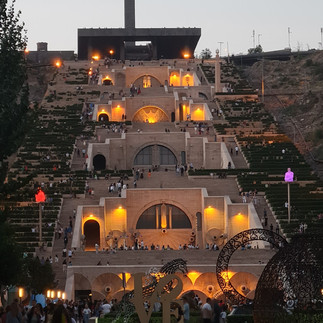
The Cascade - a giant stone staircase outside the Museum of Art. It’s incredibly unique and each level of the complex showcases different micro gardens and sculptures. We climbed to the top of the 570 stairs and it was well worth the effort as the unrivalled view sweeps across the city’s skyline to Mt Ararat. The area is like a public square and is one of the best things to do in Yerevan for free.
Opera Theatre - one of the best examples of heavy Soviet architecture, designed and built by the Soviets in 1930s, it holds ballet and opera performances regularly. The surrounding park area is also popular for families to congregate on sunny afternoons and summer evenings.
Republic Square - a huge imposing square in the heart of the city and where a lot of the streets’ buzz emanated from. The fountains were full of water and people were relaxing on one of the benches, it was especially lively in the evening when the dancing fountains, lights and music were turned on for everyone to enjoy. It’s quite impressive and when you enter the square for the first time, it’s impossible not to be taken aback by the grand stone buildings, which are very reminiscent of the Soviet times.
Vernissage Market - an open-air flea market which is held daily but best to visit on weekends, as we did, when it’s most busy. There’s everything from Soviet memorabilia to carpets to jewellery and any souvenir you could possibly want. You can easily spend a couple of hours here looking at each stall.
The GUM Market - a large covered fresh produce market where locals come to buy all their food from local vendors. You can find butchers, bakers, farmers as well as vendors with dried fruit and nuts.
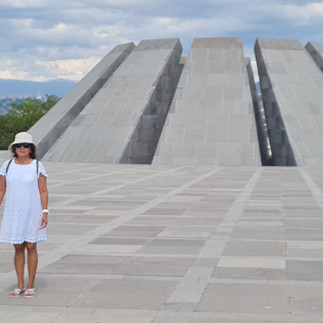
Genocide Museum and Memorial - a very moving monument up on the hill above the city is dedicated to the 1.5 million victims of the Armenian Genocide. There is an eternal flame inside the concrete monument which we also entered to pay our respects.
The Genocide Museum documents in raw and eye-opening detail what happened to the Armenian people at the hands of the Ottoman Empire during the First World War. It’s extremely well presented with English descriptions. We also took a museum guide who was commenting the atrocities as if she was describing a cooking recipe while our stomachs slowly turned and we felt quite ill. However, it’s a must-see in Yerevan to fully understand the people of Armenia. It’s still considered a contentious international issue, as some countries, including Turkey, do not recognise the genocide as ever happening.
Bar and cafe hop - the wine and coffee culture is strong in Yerevan. There were open-air cafes and bars everywhere and they were very lively in the warm weather. Our favorite restaurant was the Tavern which we were told was the best place to go for traditional Armenian food and it did not disappoint.







Comments