
Yellowstone National Park - rotten eggs and airwicks
- atricgery
- Jan 12, 2023
- 3 min read
Updated: Jan 13, 2023
17 October 2022
We had been told that October was a good month to visit the Park to avoid the zillion other visitors milling around its attractions. It turned out to be good advice because apart from a 90-minute traffic jam due to a herd of bison changing pasture, there were no queues at all. On the other hand, the Park was already starting to close down for the winter and there was no accommodation available: we had to drive 45 minutes back into Idaho to get a bed for the night.
Locals like to say there’s never a bad day in Yellowstone. But some activities are better than others. Here is our list of what we enjoyed the most in this Park like no other.
Near the top of our list was the slow drive along the north shore of Yellowstone Lake. The easy trail to Storm Point is worth a half hour’s walk, or more if the wind is calm and the boulders are comfortable for sitting. A few miles east, a side road leads to Lake Butte Overlook which offers views across North America’s largest alpine lake to the Teton range 100 miles south.
From the lake, Yellowstone River flows through the rolling, open hills of Hayden Valley, famous for wildlife viewing. At sunrise, the river is often shrouded in mists that have gathered in the cool of the night. Shaggy bison appear and fade away like ghosts on a stage.
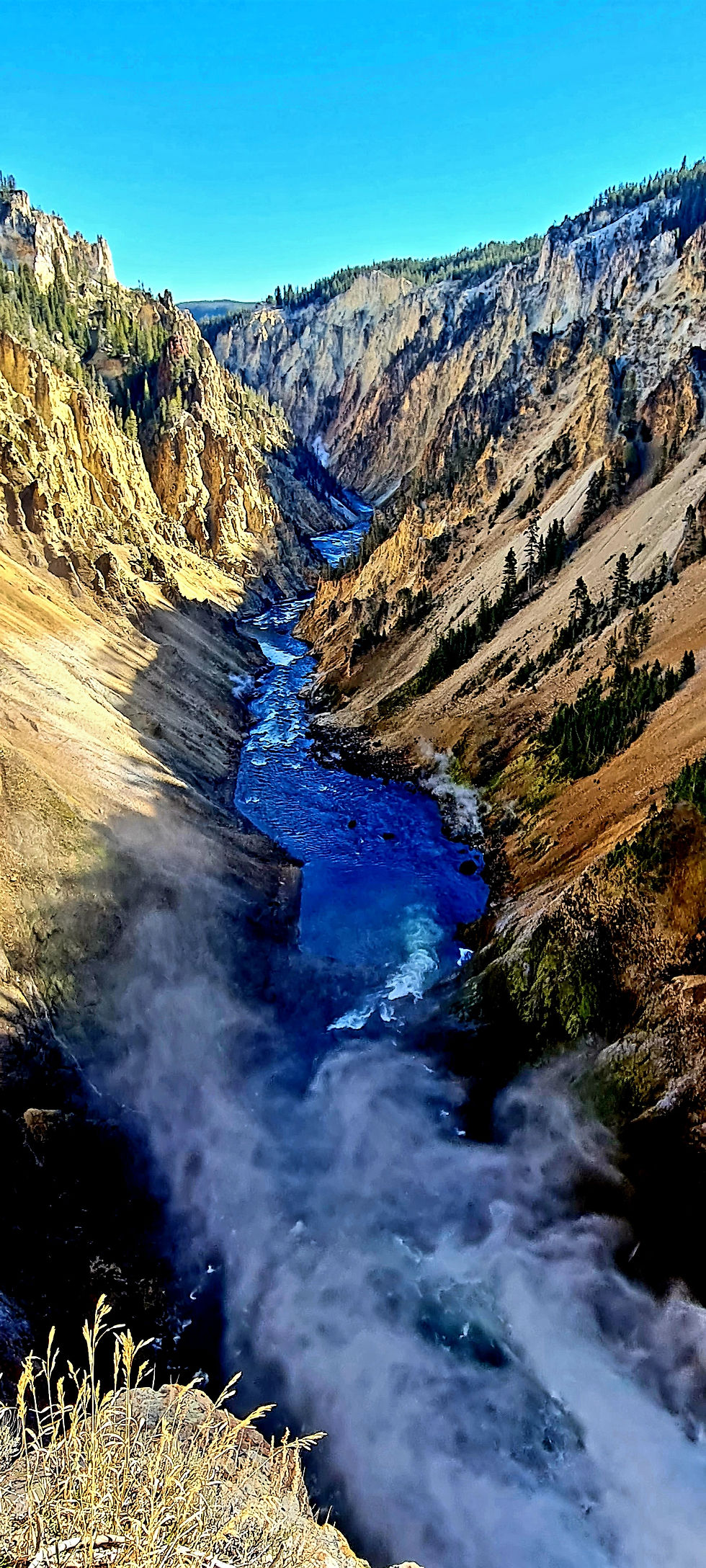
Then, a few miles north, the river enters the Grand Canyon of the Yellowstone, a great yellow gorge with two towering waterfalls. The main overlooks are splendid, but walking the rim trails provide the best range of views, along with quiet spots where we could dangle our feet over the edge and ponder the power of erosion.
Of course, there's always Old Faithful Geyser, the icon of Yellowstone and truly a marvel of regularity. Eruptions every 90 minutes or so can shoot between 14k-32k litres of boiling water to a average height of 44 metres lasting from 1+1⁄2 to 5 minutes. Even in October the place was crowded with expectant spectators although somehow Old Faithful disappointed, the anticipation exceeded the actual spectacle itself.
From Old Faithful, a boardwalk winds over Geyser Hill, where thermal features are packed in so tightly you think they must be having a convention. Somewhere within sight, a geyser is almost sure to be erupting. The trail continues along the Firehole River, past steamy pools and geysers great and small – all of them promising to erupt if you just wait long enough. Sawmill is among the likely; it erupts often to about 25 feet high. Giant, on the other hand, bides its time, brooding perhaps for years before exploding to 250 feet or more. The main trail ends at Morning Glory Pool, a quiet beauty. Most people turn around at this point, but five minutes farther lies the aquamarine frothing gem called Artemisia.
Speaking of hot water, the biggest springs in the park are found in Midway Geyser Basin north of Old Faithful – just two, in a sort of enormous yin-yang embrace. Both are roughly 100 metres across but one, Grand Prismatic Hot Spring, is the picture of calm, surrounded by coloured streamers of heat-loving algae and bacteria. Close beside it, Excelsior Geyser is a rock-rimmed lake of ever-boiling turbulence.
A special mention also for Beryl Spring, small but conveniently located by the side of the road and apparently the hottest spring in the Park. The steam it generates is tremendous and it transformed the early morning frost on the nearby vegetation into a winter wonderland.
In terms of the wildlife, we were fortunate to be able to get up close to bison (perhaps even too close on one occasion, they are after all still wild animals). We also stopped when the driver of the car in front supposedly sighted a bear but it proved elusive. Later that day we did see some elk grazing peacefully by the side of the road. That was the extent of it.
We spent 2 calm, sunny days in Yellowstone, admiring its natural wonders, taking in its fresh mountain air and hiking along steep trails, gazing at the wonderful views around us. Not everyone shared our enthusiasm. We overheard one visitor complain about the smell. Everywhere you go, he said, there’s this lingering smell of rotten eggs (it was the sulphur). You’d think for the $35 entrance fee, the Park people could install some airwicks, he added. Priceless.
On day 3 we headed off towards our next destination, Grand Teton National Park, wondering how could it be better than what we had already seen.




Comments