
Visit Kazakhstan, it’s very nice!*
- atricgery
- Aug 6, 2022
- 6 min read
Updated: Aug 20, 2022
(*local tourist slogan)
17 July 2022.
Most Central Asian states have a unique selling point. For Uzbekistan it’s antiquity, for Kyrgyzstan it’s mountains, for Turkmenistan it’s because they honestly don’t want you there. And Kazakhstan? Its vastness perhaps? At no more than 18 Kazakh citizens per square mile, people are still rare, and often outnumbered by wolves. Space is what Kazakhstan does best.
Thirty years on from post-Soviet independence this land of 18 million people, three time zones, incredible natural wealth and the size of western Europe remains little visited.
For centuries an integral part of the Silk Road’s ancient trading route, the world’s largest landlocked country now borders Russia, China, Uzbekistan, Kyrgyzstan and Turkmenistan. Above the inland Caspian Sea, a small portion of Kazakhstan falls west of the Ural line, technically European. To the south, the Aral Sea has become a dusty wasteland traversing the Uzbek border, fertile fisheries sacrificed for cotton plantations. From sub-sea level depressions in the west, the 7,000m peaks of the Tian Shan and Altai mountains describe international borders in the southeast and east. To the north lies almost half a million square miles of Central Asian steppe, grasslands becoming semi-desert towards the south.
In answer therefore to the question, “Where to go in Kazakhstan?”, we had to accept that it’s impossible to ‘do’ Kazakhstan in anything approaching a normal trip. Better to adopt a more manageable focus: the Almaty Region, larger than mainland Great Britain, had seemed like a good place to begin.
With Nurdariga’s help, we contracted a two day lake and canyon tour with a local agency. The bus surprisingly left Almaty at 9pm in the evening (to avoid the notorious Almaty traffic jams according to the driver) and so we drove east through the dark, eerily quiet, moonlit night, almost alone on roads which seemed to get narrower as the bus climbed and climbed further into the mountains. Finally at 3am in the morning we reached our destination, a small village called Saty, close to the lakes. The bus passengers were distributed to various dwellings in the village.
Our guest house looked like a cross between an abandoned farm and a building site where work had abruptly stopped. We gingerly made our way in the dark from the bus into the house and to our room, guided by a grumpy-looking owner who was still waking up (well I would be grumpy too if I was awakened at 3am in the morning). It was a small box room with a single piece of furniture, a sagging bed that looked so old it may possibly have been used by Genghis Khan himself when he swept through here on his way to sack the rest of Asia. We had paid a supplement to have access to «VIP facilities». It was at that point in the middle of the night in the middle of nowhere that we were informed by our guide what that meant: we had our own room rather than having to share with half a dozen other passengers. We would however have to share the bathroom and shower with everyone else. VIP apparently meant an inside toilet rather than a hole in the ground outside in the dark.
Too tired to discuss further, we returned to the Genghis Khan Suite and fell into a deep slumber, only to be woken by the alarm clock some five minutes later (it was actually three hours). Breakfast was a salty rice pudding, miniature Snickers and dry biscuits with lashings of hot milky tea to wash it all down. Most of our fellow passengers had brought their own food, maybe it was not their first time here...
We all then climbed into an ancient Russian bus that may possibly have witnessed the Bolshevik revolution and we were off. However, any misgivings we may have had about the wisdom of going on this trip were dispelled as soon we left the main road. As the bus spluttered and wheezed its way up a dirt track into the Tien Shan mountains we looked around us at the scenery, it was stunning. Swathes of Central Asian firs tumbled down mountains, a series of jagged peaks like spikes on a dragon’s back. Fast clouds cast shadows over a flock of horned cows grazing outside yurts and a kite wheeled through the luminous blue air. A boy raced down the hillsides on his swift steed, horse and human one fluid unit. The silence was deafening.
The bus eventually stopped at a parking site and and after a one-hour hike, during which we got to know our fellow passengers a little better (especially Anipa and Sultan, two delicious ladies from Kazakhstan and Turkmenistan respectively), we reached our first lake, Lake Kaindy. The limestone blue lake was formed in 1911 when an earthquake triggered a landslide, which in turn led to a natural dam. Located at an altitude of 2,000 meters, it is mainly known for its submerged forests: dried out trunks of spruce trees rise out of the lake. It is quite fascinating as after all these years the trees have still not decayed. We approached the lake to dip our toes in it but swimming was out of the question as the water was ice cold.
Then it was back to the bus which brought us to a nearby yurt for a lunch of kuurdak (braised meat and potatoes) and pilov. Luckily we had avoided what passes for the national dish, beshbarmak, prepared from boiled horse meat and served on a bed of noodles. The Kazakhs do have a strange relationship with their horses. They both revere and eat them. Horses are everywhere and the Kazakhs are very skilled horsemen. We were told that a herdsman in Kazakhstan rarely slaughters a saddle horse that he rode for his entire life. Usually, a retired saddle horse is returned to the wild to complete his last days. On the other hand, other horses are killed in the country for consumption as meat.
Our afternoon lake visit was to Lake Kolsai, situated at an altitude of 1000 meters. Contrary to the first lake, there was a hive of activity on and around this lake as visitors took to the pedalos (pedal boat) and rowing boats for a tour on the water. We did the same, accompanied by Anipa, Sultan and a couple from the US of Iranian extraction, Saied and Zahra. After a rather difficult start, it was actually quite fun and as I rowed I thought of my mother (daughter of an Irish fisherman who spent his working life in such a boat) who astonished me with her skill the first time I saw her handle the oars.
After a dinner of Manti (Uzbek dumplings) back at base, we made our way to a campfire where Yenlik, our charming guide, proceeded to entertain us with innocent fun and games for the next two hours. It ended with a guitar-accompanied sing song of course. I have to admit that it was strange for me to see people having to look up the lyrics of «Let it Be» on Google before joining in. I thought the whole world knew that one (wrong again).
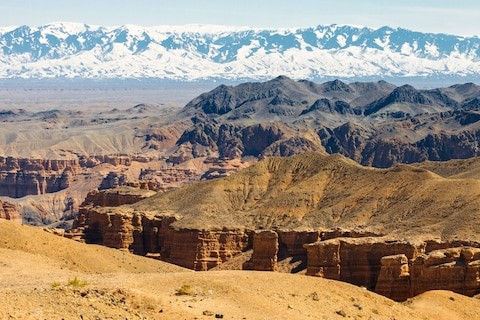
The next morning, we set off to visit three canyons - Black Canyon, Lunar Canyon and finally, Charyn Canyon, before heading back to Almaty. They were all very impressive but the most stunning was Charyn - multicolored, enormous and thoroughly instagrammable. Charyn is Kazakhstan’s answer to the Grand Canyon. It stretches for almost 150 kilometers close to the Chinese border, a deep 300 meter scar carved through layers of red sedimentary and volcanic rock by a tributary of the Ile River.
We walked the length of the canyon’s remarkable Valley of the Castles (so called as some of the cliffs look like fantastical figures) and felt its walls closing in on us in the scorching heat. Reaching the river at the bottom, we cooled our aching feet in the shade of the trees by the river bank. We had also planned to stand on the top of the canyon and look down on the way back, no doubt a truly inspiring sight, but by this time we were fully dehydrated and we could only stagger back to our bus for some refreshments.
Back in Almaty we took our leave of our guide and fellow passengers after an eventful two days. We had seen but a minute (and beautiful) part of this vast country but it had been very instructive. Further trips would be needed to discover more of this wild and remote frontier land occupying such a vast space between Europe and Asia.





Comments