
Vietnam Tour (2of3): Hue and Hoi An
- atricgery
- Feb 15, 2024
- 4 min read
Updated: Feb 18, 2024
19 January 2024

Situated on the bank of Song Huong (Perfume River), Hue is located right in the middle of Vietnam, 700 km south of Hanoi, and 1100 km north of Saigon. During the last royal Vietnamese era, Hue was the Imperial capital of the Nguyen Dynasty. And until 1945, this city was both the national capital, and the cultural and religious centre of the country.
Gigantic complexes of imperial tombs and pagodas are scattered all along the Perfume River. The highlight of Hue is however the Imperial City, surrounded by a Citadel which consists of a 2 km x 2 km wall and a huge moat. The inside of the Imperial City is divided into several zones: the Worshipping Zone, the Great Ceremony Zone, the workshop zone, the residence of the emperor’s mother and grandmother, and many more.
The Imperial City is perhaps the best place to see how the original Chinese imperial architecture was adapted by Vietnamese civilization. After all, this royal city is an emulation of the Chinese Forbidden City: it was built after the one in Beijing, according to Emperor Gia Long’s wish.
At the heart of the Imperial City lies the famous Forbidden Purple City, surrounded by brick walls. Like the (other) Forbidden City in Beijing, only the Imperial family, concubines, eunuchs, and the emperors’ associates were allowed to access the Purple City.
During the Vietnam War, Hue suffered a lot of damage due to its location near the border dividing Vietnam into North and South. Today, declared as a World Heritage Site by UNESCO, many historical monuments are still being restored.
We wandered around the ruins, restored buildings and gardens for a few hours and time seemed to slow down. Peaceful and secluded, the complex lends itself to relaxation, contemplation or meditation. Much as the royal family would have undoubtedly done.
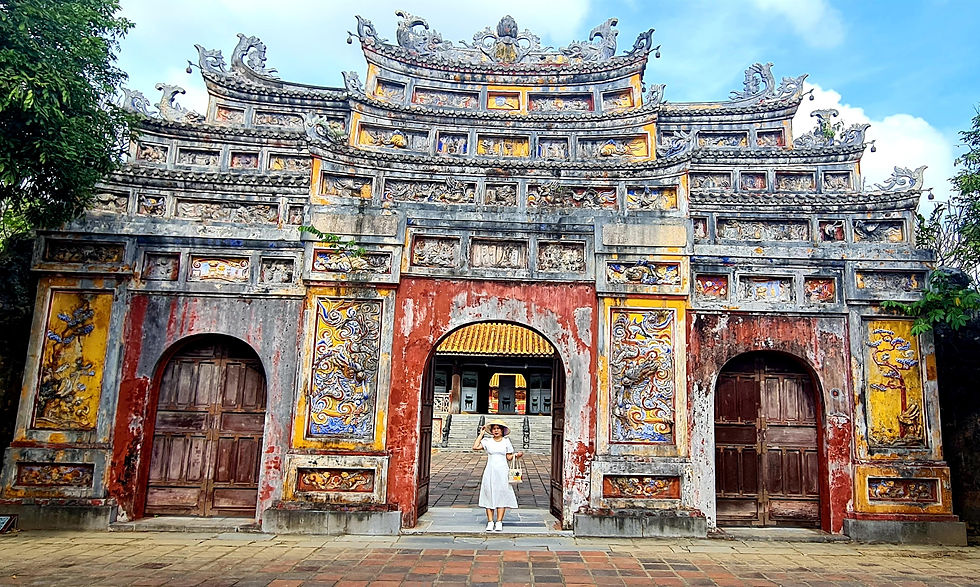
Afterwards, we strolled along the shore of the Perfume River and lingered in the busy central market. After lunch, we then boarded a bus for Hoi An. It stopped in Da Nang on the way, with its cool, holiday vibe and golden coastline flanked by luxury hotels. It was on these same beaches that the first American combat troops came ashore, in March 1965. Times change.
Reaching the bus station at Hoi An, we were picked up by a cab and brought to the Enso Retreat, situated about 20 minutes outside the town. It was very a relaxing resort and we were properly spoiled by Thao, the delectable front desk manager, who embarked on a personal mission to keep us happy and smiling throughout our stay (she succeeded).
With its old-world architecture, cobbled streets, and distinctive yellow shop fronts festooned with colorful lanterns, it’s no wonder Hội An is considered one of the most beautiful places in all of Vietnam. Yet there’s more to it than awards and postcard-perfect beauty. The town boasts a long history of drawing people from across the world.
Archaeological evidence suggests a trade in the region was happening as early as the second century BC. Hội An grew into a bustling trading port. During the Cham Dynasties (7th-10th centuries), it was an economic hub, where merchants from Asia, Persia, and Arabia traded. Later, the famed Silk Road maritime route saw ships from Europe start flocking to the port. From the 15th to 19th centuries, Hội An was a major Southeast Asian trading post. Here, goods were traded, and ideas and cultures were shared.
Today, tourism is the town’s major trade. But evidence of its fascinating history is everywhere. With its historical buildings and mix of European and Asian architectural styles, there was plenty to admire during our 4 hour walking tour of the old town. The original street grid plan remains as it was, and 844 of the 1107 buildings making up the townscape are on the UNESCO World Heritage list.
Walking the streets of Hội An was like moving through a living museum. With our Old Town Ticket purchased at the entrance to the old town, we also got entry into five of Hội An’s heritage buildings.
Given its estuary location, traditional boats are another distinctive feature of the town. The river that’s welcomed generations of trade is still a source of livelihood for many locals. A boat trip is a cooling, soothing way to experience a city from its waterways and we took a one-hour sunset cruise on one of the sampans with its colourful lanterns that lined the riverside.
Situated some 40km from Hoi An is My Son temple sanctuary. The complex consists of more than 70 buildings dedicated to Hindu gods and goddesses and was also the political centre and a royal cemetery. Often compared to the immense temples of Angkor in Cambodia, it is much smaller and in generally poor shape but the beautiful, intimate nature of the site, in the jungle, surrounded by gurgling streams and high mountains, makes for an enthralling experience, especially at sunrise or sunset.
My Son was built by the Champas who controlled Central Vietnam from 200 – 1700 until it was annexed by the Vietnamese in the 19th century. Red bricks without cement were used to build the temples, with sculptures of animals, gods and priests. They used soft stones to build the walls that were baked at a low temperature and placed on top of each other. When the temple was completed, they set it on fire to make the stones hard and lock them in place. No cement was used, but there are no holes.
The jungle began to reclaim the complex after the fall of the Champa Kingdom. Eventually the temples were completely covered in jungle. The French discovered this complex in 1898 and started to restore it. In 1960 the Viet Cong used My Son as a base and for hiding. Even though the US Congress banned the bombing of My Son during the Vietnam war, unfortunately it suffered by bombings. However, most of the central complex managed to survive the bombs and parts of the ruins have now been rebuilt
Our visit to My Son was completed by a traditional dance show before we took a boat back down the Mekong river towards Hoi An.


Our next stop was Ho Chi Minh City, a 90 minute flight from Da Nang airport.


Comments