
Sofia and the “Triangle of Religious Tolerance”
- atricgery
- Aug 10, 2024
- 3 min read
1 July 2024

Bulgaria's laid-back capital is no grand metropolis, but it's a proud, modern and youthful city that has been sculpted over more than two millennia by Thracian, Roman, Ottoman and Russian influences.
The scattering of onion-domed churches, Ottoman mosques and Stalinist architecture give it an eclectic, exotic feel. Away from the buildings and boulevards, vast parks and manicured gardens offer a welcome respite. Home to many of Bulgaria's finest museums, galleries, restaurants and clubs, Sofia proved itself to be most definitely worth the detour. It is also doable on foot. We started with its centerpiece.
The Aleksandâr Nevsky Cathedral is one of the symbols not just of Sofia but of Bulgaria itself; a massive, awe-inspiring church built between 1882 and 1912 in memory of the 200,000 Russian soldiers who died fighting for Bulgaria’s independence during the Russo-Turkish War (1877–78).
Sveta Sofia is one of the capital's oldest churches, and gave the city its name. An impressive subterranean museum houses an ancient necropolis, with 56 tombs and the remains of four other churches. Outside are the Tomb of the Unknown Soldier and an eternal flame, and the grave of Ivan Vazov, Bulgaria's most revered writer.
Just above the Serdika metro station nearby are displayed the remains of the Roman city, Serdica, that once occupied this area. The site was discovered in 2010 during construction of the metro. There are fragments of eight streets, an early Christian basilica, baths and houses dating from the 4th to 6th centuries.
We then wandered down Tsar Osvoboditel, pausing to take in the charming bauble-capped Saint Nikolas Russian church. Next up was the Rotunda of St George - the oldest monument in Sofia. This early Christian red brick rotunda hidden in a courtyard dates from the fourth century, when it was a pagan temple. It is itself a potted history of the city, housing layers of frescoes dating back to the 10th century.
Nearby, we witnessed the Changing of the Guard at the President’s Palace, another Soviet-style building. Around the corner was the National Archaeological Museum. The façade of the museum belongs to a 15th century Ottoman Empire mosque, and its interior holds artefacts from the many empires of old that have occupied the city.
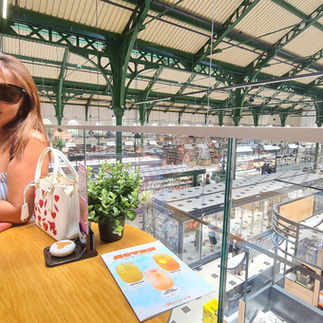
Beside the Central Market Hall (where you can find great coffee and delicious desserts) is another of Sofia’s architectural monuments, the Synagogue, the third-largest in Europe.
Sofia has been described as the "triangle of religious tolerance". This is because three temples of three major world religions - Christianity, Islam and Judaism - are situated so close together you can put them all on one photo: Sveta Nedelya Church, Banya Bashi Mosque and the Synagogue.
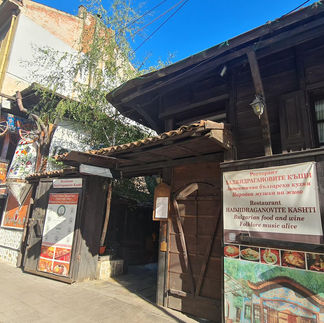
By now, it was now time for dinner and so we took a taxi to Hadriganov's Houses, a kitsch but charming restaurant serving traditional Bulgarian fare. Built in 1866 and spread across four restored houses, the stylings are theatrical but the food is good and inexpensive. After dinner, we took a taxi to the National Football Stadium where a fan-zone had been set up to watch the evening's games.





The next day, we took a guided tour to Plovdiv, a two hour drive from Sofia.
Like Rome, Plovdiv straddles seven hills; but as Europe’s oldest continuously inhabited city, it’s far more ancient. It is best known for its romantic old town, packed with colourful and creaky 19th-century mansions that are now house-museums, galleries and guesthouses.
Plovdiv’s magnificent 2nd-century AD Amphitheatre, built during the reign of Emperor Trajan, was uncovered during a freak landslide in 1972. It once held about 7000 spectators. Now largely restored, it once again hosts large-scale special events and concerts. While the once-huge 2nd-century Philippopolis Roman Stadium is mostly hidden under a pedestrian mall, there are stairways from different sides allowing for exploration.
It would have been criminal to leave Plovdiv's old town without checking out the Ethnographical Museum, a stunning navy-blue mansion. Well-manicured flower gardens surround it, ornamented with golden filigree and topped with a distinctive peaked roof.
Another of Plovdiv's most beautiful Bulgarian National Revival–era mansions is Balabanov House, an enjoyable way to experience old town nostalgia as well as contemporary art. The lower floor has an impressive collection of paintings by local artists, while upper rooms are decorated with antiques and elaborately carved ceilings.
We came away from our trip to Bulgaria with a very positive impression of the country and its people, who unfortunately often get bad press in the West. The long-expected invasion by poverty-stricken Bulgarians following their country’s accession to the EU did not materialize and after visiting Sofia, we could understand why. That is the beauty of travel.


Comments