
Peru - Part 1: Puno & Lake Titicaca

14 May 2025
We took our first ride with PeruHop from La Paz to Puno. This was the hop-on, hop-off bus company with which we would explore most of Peru over the next three weeks. They had been recommended to us by friends and it turned out to be an excellent tip.
The first trip brought us to Copacabana, a small town on the Bolivian side of Lake Titicaca. We decided not to take a lake cruise from there, preferring to wait until we got to Puno, on the Peruvian side.

That evening, another PeruHop bus took us to Puno. Our hotel was located close to the colonial-era baroque cathedral and the Plaza de Armas, the vibrant centre of the city.
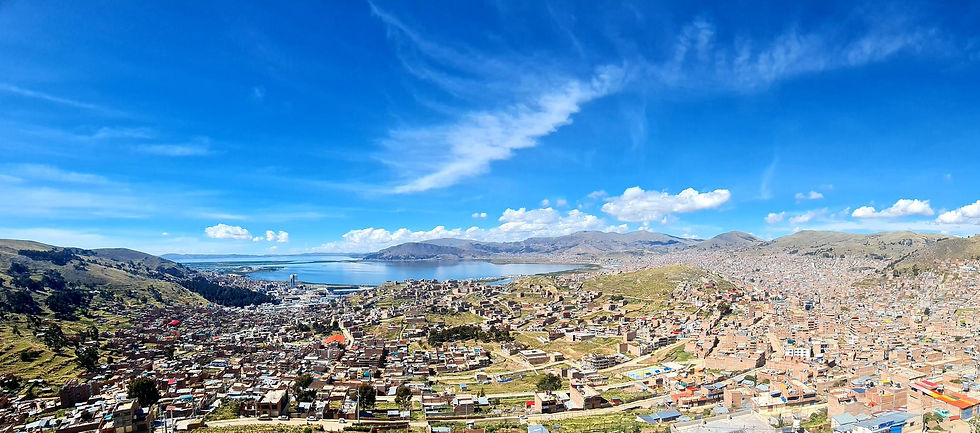
The next morning, we were transferred to the main port and we boarded a fast boat which took us to visit the floating islands of the Uros on Lake Titicaca. At 3800 metres above sea-level, the lake is said to be the world’s highest navigable body of water. It is also said to be the birthplace of the Incas and the Inca ruins can in fact be found on numerus islands on the lake. Its waters are famously still and brightly reflective. Around it is Titicaca National Reserve, sheltering rare aquatic wildlife such as giant frogs.
We disembarked on Uros and through an interpreter the local chief presented his people, their story and culture to us. He explained that we were standing on floating mats of dried totora. Totora is a reed that grows in the marshy shallows. Everything is made from totora, including their huts and boats — all are bundles of dried totora tied together. They not only make the islands out of totora but also replenish their bases with fresh totora every fortnight. No surprise therefore that Uros is also called the floating islands. We then went to visit their huts, which were very small and full of handicrafts which they tried to sell to us.
Overall, it felt rather like a tourist trap. While it was a fascinating experience to learn about the unique totora reed island culture and meet the indigenous people living there, it felt overly commercial, focusing on sales pitches for artifacts and reed boat rides. The islands were crowded with many similar boats and our visit was really too short to connect properly with the local people there.
Our next port of call was the island of Amantaní. The island is very quiet, with no roads or vehicles – you won't even see a dog, as they aren't allowed. The island boasts lovely views, too. Several hills are topped by ruins, among the highest and best-known of which are Pachamama (Mother Earth) and Pachatata (Father Earth). These date to the Tiwanaku period, named for a largely Bolivian culture that appeared around Lake Titicaca and expanded rapidly between 200 BC and AD 1000.

Overnight stays are organized with families there, giving a privileged glimpse into the local way of life. We however, had already moved on to our last stop, Isla Taquile for a late lunch, followed by the return trip by boat to Puno.


Comments