
Japan Tour (8) – Osaka: The Last Stop
- atricgery
- Oct 30, 2024
- 4 min read
27 September 2024

Osaka, like its big brother, Tokyo is a sprawling, modern metropolis but in many aspects it is very different. For example, it’s architecture isn’t as historic or as pretty as Tokyo’s, or Kyoto’s, even though it has a rich past too. However, it is one of the nation’s principal economic and commercial hubs and perhaps better represents the real, everyday Japan.
It is also celebrated as the foodie and party capital of Japan. Nowhere apparently parties with quite such commitment and nowhere is quite so ready to supply you with marvelously salty, deep-fried street food washed down with a beer (Asahi lager was founded here). We experienced this for ourselves at first hand.
We had met up with our group for the Guru walking tour one morning at Ebisu Bridge in Dotonbori, in downtown Osaka. We were told by our guide that we should return there again in the evening when the whole area really comes to life, in the shadow of a hundred illuminated billboards. So, that same evening, we duly obliged.


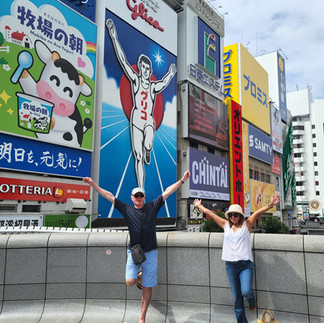


Glimmering off the surface of the canal below, the largest billboard was the Glico Man, the mascot for a Japanese confectionary company who is depicted running with arms outstretched in front of the rising sun (a mascot based originally on an actual Filipino sprinter, Fortunato Catalon). You could barely move in front of this sign for all the tourists mimicking his pose for their Instagram.
The view from the bridge was quite something. The intensity of the billboards, the canal boats packed with awestruck tourists, combined with the smell of street food and young women coaxing passers-by to a nearby club, bar or karaoke shop made for an alluring spectacle, like a backdrop for Blade Runner. There was even litter on the ground.
It was all the contrary to Tokyo with its polished skyscrapers and sparkling streets. Here, power cables snaked above, half-empty beer cans sat overlooking the river and steam bellowed from restaurant kitchens. The streets and back-alleys had a rough-around-the edges feel, Osaka was a gritty, living and breathing city with its own personality.


While in Dotonbori, we feasted on two of Osaka’s culinary inventions, Takoyaki (delicious little wheat balls stuffed with fresh octopus and smothered in sauce) and Okonomiyaki (a type of cabbage omelette laden with thick sweet and creamy sauces). I had to cleanse my tastebuds with an ice-cold beer afterwards.

Then right before us as we walked down a street full of bars and clubs, we came across a shrine, Hozenji. Passers-by paused to make an offering to Fudo Myo-o, a Buddhist spirit that represents discipline and firm moral character. So many people have thrown water on Fudo Myo-o that now a layer of green moss covers his grumpy face.


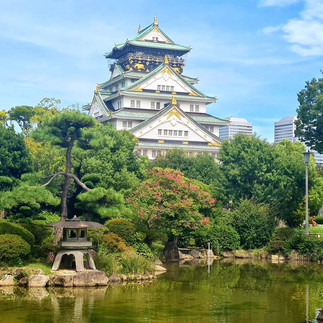
Our “walking tour” then took the metro to bring us to Osaka Castle, a sprawling site alive with trails, parkland and a castle that offers sweeping views over the city. The castle is not one of the remaining 12 original castles in Japan but nevertheless it is still one of Japan’s most famous landmarks and played a major role in the unification of the country in the 16th century.




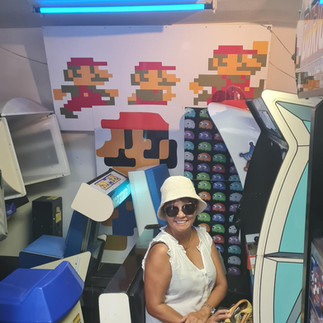
Our walking tour ended in Shinsekai (“New World”), a retro neighbourhood that is a time capsule of old-school Osaka life. It was like stepping back in time, with its arcade machines, quirky shops, hidden bars and street food. Again, the whole area reminded us of Blade Runner.




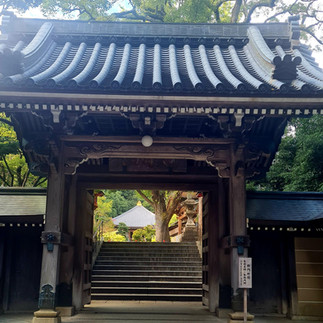
No visit to a city in Japan would be complete without a pilgrimage to a temple. We chose Seichoji, a twenty minute hike up the “path of the dragon” from Takarazuka station, about an hour’s train ride from Osaka. Perched at the foot of a mountain, it was a haven of peace and relaxation, with its own waterfall. We were almost the only visitors there, a welcome change from most other temple sites we visited.
Seichoji is an ancient temple, founded in 896, where both Shintō and Buddhist beliefs are practiced. With their own structures standing side by side in harmony, this is a place that apparently overflows with a special healing energy. Two giant gingko trees, both believed to be more than 400 years old, greet you as you enter the sanmon (temple gate). At the foot of the stone steps leading to the hondō (main hall) stands a giant bronze statue of the Jizō (the Ksitigarbha bodhisattva). They say that if you make a wish while pouring a ladle of water on it, your wish will come true. Mylene duly obliged but what she wished for will remain a secret forever...



Our final day trip was to Osaka Aquarium. Built on an artificial island beside Osaka port, it used to be the biggest of its kind in the world. A total of 14 exhibits represent different ocean zones around the Pacific, with animals gathered from as far away as the Aleutian Islands (tufted puffins) and Antarctica (king penguins).. The star however must be the hugely impressive whale shark. As with any reputable establishment keeping captive animals, the focus now is on conservation and species preservation rather than simply entertaining visitors.


The next day we headed off to the airport, our twenty-five day odyssey around Japan had come to an end. Our heads were full of unforgettable images of this very unique country. We had been subjugated by its people, its culture, its history, its food, its difference, its uniqueness. Yet we had the impression to have only skimmed the surface. We were convinced that there was more than enough that we did not see or experience to make a return trip very soon to the land of the rising sun.





Comments