
Georgia - a Country devoted to St George
- atricgery
- Jul 28, 2022
- 4 min read
Updated: Aug 2, 2022
13 June 2022
Contrary to popular belief, many Georgians know their homeland as Sakarvelo. It’s not entirely clear where «Georgia» came from but according to one theory, it was coined by Christian crusaders in the Middle Ages on account of the country’s devotion to St George.
Imagine a small country with mountains higher than those in Switzerland, a country with thousands of vineyards, with sunny beaches, ski resorts, dashing rivers and with forests covering nearly 40 per cent of the land area. Georgia has all this and more.
Its location at the meeting point of two continents - Europe and Africa/Middle East - provides Georgia with its cultural mix. It’s an old land whose inhabitants claim descent from Noah and whose flocks provided the Golden Fleece. Later, this fertile avenue between the Black Sea and Caspian Sea was overrun by Romans, Persians, Arabs, Tartars, Turks and Russians. Yet Georgia has a very strong, independent culture, with its own alphabet and language and with a passionate commitment to those bastions of identity, namely food, drink and customs. We set off to find out more.
Ananuri, Gudauri, Kazbegi: Driving north up the Military Highway, where thousands of Russian trucks were blocked on the side of the road awaiting authorization to cross back into Russia (apparently a retaliatory action by the Georgians to the invasion of the Ukraine), we first stopped at the Ananuri Fortress, a castle and seat of the Dukes of Aragvi, a feudal dynasty which ruled the area from the 13th century. The castle was the scene of numerous battles and is unfortunately falling into ruin. Our minibus then climbed steeper into the Caucasus Mountains up to 2300 metres, past the Gudauri ski resort and through the Jvari pass and gorges with steep valleys towards the Kazbegi Mountain. At 5,047 metres above sea level, it is the third highest mountain in Georgia, and is surrounded by myths and religious tradition. We ended our trip taking in the beautiful views of the mountain from the picturesque Gergeti Trinity Church.
Kakheti Wine Tour: Wine is everything here, Georgia has 8000 years of unbroken tradition of winemaking and is now universally recognized as the homeland of wine (according to one version, the word «wine» is derived from the Georgian “ghvino”). There are more than 500 different endemic species of grape, producing unique Georgian wines such as Saperavi, Rkatsiteli, Kindzmarauli and Tvishi.
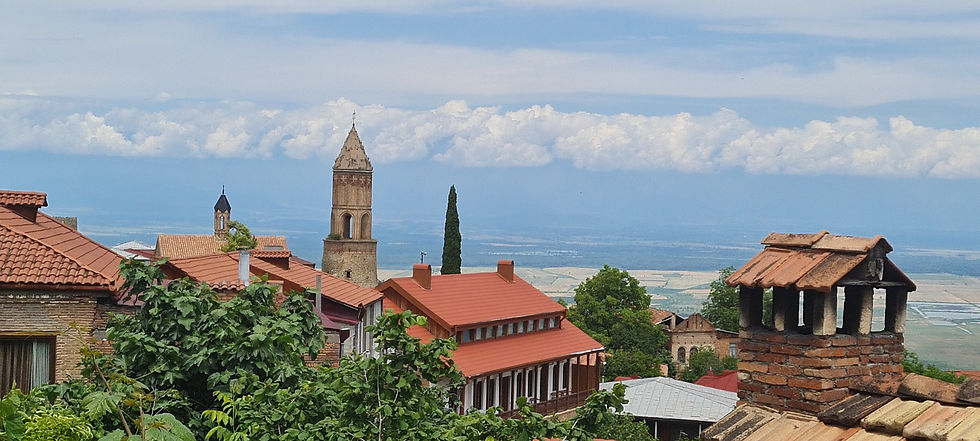
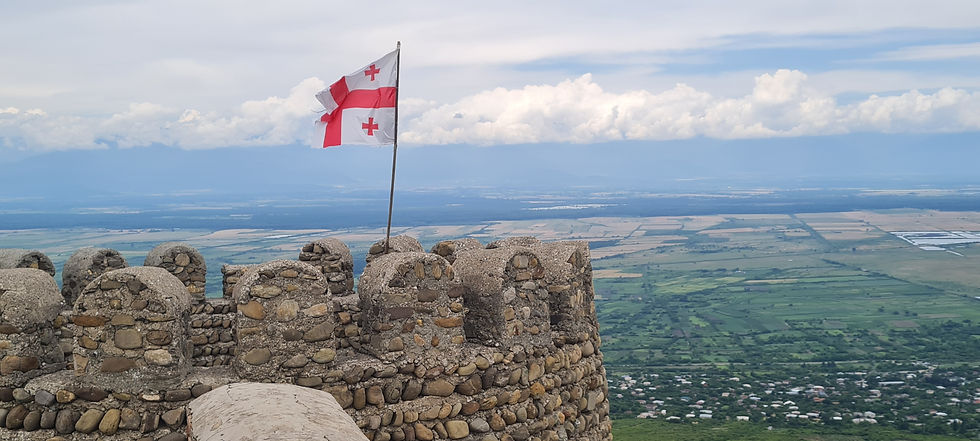
We headed towards Kakheti, the mountainous eastern region bordering Russia and Azerbaijan. It is Georgia’s cradle of winemaking, where 75 per cent of all Georgian wines are produced. Our tour took us first to Signagi, the region’s wine capital, and a fortified town overlooking the Alazani Valley. We stopped at the 8th-century Bodbe Monastery, containing the remains of St Nino, who arrived from Turkey in the 4th century to evangelise the Georgians. Then on to Telavi, where we also made a stop, this time to gape in awe at a 900 year old sycamore tree. Finally, we arrived at the wine estate, just outside Tsinandali.
Here, the passionate local wine growers explained to us the traditional way of winemaking, called Qevri, which is actually an egg-shaped earthenware vessel used for making, ageing and storing the wine. Knowledge and experience of Qvevri manufacture and wine-making are passed down by families, neighbors, friends and relatives, all of whom join in communal harvesting and wine-making activities. The wine-making process involves pressing the grapes and then pouring the juice, grape skins, stalks and pips into the Qvevri, which is sealed and buried in the ground so that the wine can ferment for five to six months before being drunk. Most farmers and city dwellers use this method of making wine. Wine plays a vital role in everyday life and in the celebration of secular and religious events and rituals. Wine cellars are still considered the holiest place in the family home.
Our visit to the winery ended in a delicious wine-tasting event, including the famous cha-cha, before we staggered off to dinner to taste some of the local specialities, such as the Khachapuri (cheese bread), with lots more wine of course...
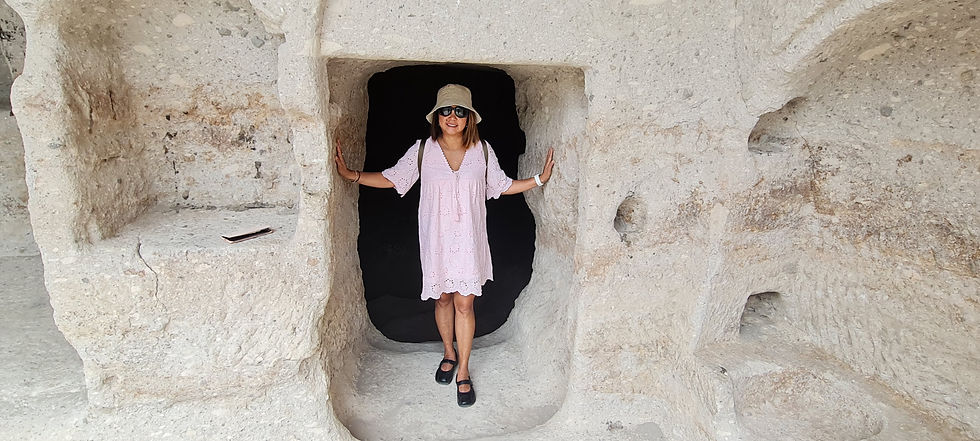
Vardzia: A three hour drive to the south-west of Tbilisi brought us to Vardzia, a rock-hewn monastery dating from the 12th century.
In the late 1100s, the medieval kingdom of Georgia was constantly under threat from the Mongol Empire and this fortified underground city, together with several other major fortresses in the south of Georgia, was once part of a defensive system. Vardzia was built in the 12th century, under the reign of King Tamar, the first woman in the history of Georgia that was ever crowned as a king (the word “queen” was used to refer to the wives of the kings in medieval Georgia).
To help her people avoid the Mongol onslaught, Tamar ordered the construction of an underground sanctuary and secretly they started building this fortress under the Erusheli mountain. t was a gigantic job but the people worked hard with the determination that their culture and lifestyle should not be destroyed by the invading Mongols. This underground fortress eventually had 13 levels constructed with natural caves and contained over 6000 rooms, including a throne room, a reception chamber, a meeting room, a bakery, a forge, chapels, and a huge church.
You might wonder how they survived here. The land on the outside of the hidden monastery was extremely fertile. The monks created a self-sustainable lifestyle by creating an irrigation system of terraced farmlands so they could produced their own food. Some tunnels had irrigation pipes that still bring drinkable water. They weren’t short on wine either because the cave city had about 25 wine cellars containing 185 wine jars.
Sadly enough the glorious days of Vardzia didn’t last very long. It kept the Georgians safe from the Mongols but Mother Nature is unbeatable. In 1283, only 100 years after its construction, a devastating earthquake literally ripped the place apart and destroyed more than two-thirds of the city and the remaining caves that were once hidden became visible.
The area was once home to 30,000 people, but is now abandoned save for seven monks who take visitors on a tour of the complex. Among the highlights are two cave chapels whose ceilings have been embellished with icons.






Comments