
Chile - Part 2: San Pedro de Atacama
- atricgery
- Aug 18, 2025
- 3 min read

2 May 2025
We flew to Catama Airport, some 1600km north of Santiago and from there, a one-hour bus ride to San Pedro de Atacama. The drive through the desert was quite surreal. We passed through a barren moon-like landscape full of just sand and rocks and as we neared San Pedro, the huge peaks and volcanoes of the Andes came into view. We entered a vast valley and caught our first glimpse of our destination: a green oasis in the middle of an expansive valley hemmed in by the Andes, the Salt mountains and a huge salt lake. The spectacular Volcan Licancabur (a 5,900m symmetrical cone) towered high above the valley floor.
The town itself was very small, almost like a prop out of a spaghetti western. Only with pick-ups instead of horses, throwing dust and sand into the hot, dry desert air (the roads were not paved). It was choking and Mylene caught an irritating cough that would remain with her for the rest of the trip. Our hostel, the Int & Killa, although very basic, was the most expensive accommodation of the whole trip. But then San Pedro is not cheap, especially the tours, and yet it seemed to us that the whole world had wanted to visit this place.
We spent three days and two nights there. For our first night, we went star-gazing. The Atacama Desert has only 30 cloudy days each year (while it rains only a few times a year, if at all). Combine that with the high altitude and the dry air and you have perfect conditions for star-gazing. As soon as the sun set, the temperature gradually dropped from 30+ degrees to just under 10 degrees. We wrapped ourselves up and went into the desert with the group to see the stars. It was fascinating. A local astrologist who owned a small observatory spoke very passionately about the sky, pointing out the various constellations, planets and stars.
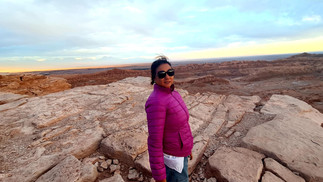
Our next tour was the Valle de La Luna at sunset, the next day. Also known as the Valley of the Moon, the area can be explored at any time, but the magic happens during golden hour when the sun sets and the valley lights up in red and gold. Like many other tours, we headed to Valle de La Luna mid-afternoon. We explored some popular spots, including the sand dunes and rock formations, before heading to a place for a cocktail and snack. After this, our bus took us to the viewpoint of Valle de La Luna to watch the sunset.
On our last day, we visited the Los Flamencos Natural Reserve, famous for its the striking red-hued rocks - the Piedras Rojas - and surrounding landscape of salt flats, volcanic peaks, and turquoise lagoons. We drove to the Salar de Atacama, stopping at the Laguna Chaxa, in the midst of the salt lake. The lagoon’s shallow waters reflected the surrounding desert landscape, while harbouring flocks of flamingos, feeding on the shrimps in the water which give them their pink colour. Their pink feathers and black beaks formed a sharp contrast with the blue lagoon, the white salt edges and the ochre mountains in the background.
We then headed up into the Andes and reached the entrance of the Laguna Miscanti. This turquoise lake is about 4,500m high and is completely surrounded by volcanoes with peaks touching 6,000m. The scenery was spectacular. We got out of the van and walked the last kilometer or so to the lake. We were completely out of breath (at these altitudes, the air is quite thin) and our heads were pounding (due to the lack of oxygen) but the scenery more than made up for that discomfort. Llamas gazed at us stoically, as if glued to the steep mountain sides.
Despite the altitude sickness, the dry heat and the dusty town streets, we enjoyed our short stay in this fascinating desert kingdom. Some degree of advance acclimatization to the high altitude is however very much recommended.















Comments