
Almaty - the City of Apple Trees
- atricgery
- Aug 5, 2022
- 4 min read
Updated: Aug 6, 2022
12 July 2022
Our routine arriving at an airport in Central Asia, after clearing customs, was to buy a local SIM card in the arrivals hall and then try to download a local taxi app to order a ride to the city center rather than be ripped off by one of the horde of taxi drivers who generally assailed us as soon as we stepped outside the terminal. All this while trying to negotiate the local language barrier.
In Almaty (Kazakhstan) however, it was different. We were met by the delectable Nurdariga, an aquaintance of my son, who had been patiently waiting for us at the arrivals. She took care of everything as we swept into our Yandex and sped off towards our downtown hotel. We were to spend most of our time in Almaty with her and she was in turn a charming host, translator, guide and travel companion as she showed us around this beautiful city of contrasts. In the end she became our friend.
Driving towards the hotel, against a backdrop of snowcapped mountains, we saw busy markets and locals squeezing into packed buses and rickety marshrutkas in the outer districts, soon to be replaced by leafy avenues and parks, expensive suburban apartment blocks, large SUVs, glitzy shopping malls and Western-style coffee lounges in the city center. Almaty already seemed like the perfect place to get to know Kazakhstan.
Almaty literally means 'city of apple trees', and, because of its relatively mild climate, it has a wide range of apple trees. The Almaty area is said to be the genetic home for many varieties of apples and the area is often visited by researchers and scientists from around the world, in order to learn more about the complex systems of genetics, and also to discover the true beginnings of the domestic apple.
Where better to start our tour of the main attractions than at the lovely tree-filled Panfilov Park and the area immediately around it. Located in the eastern-centre of the city, it is teeming with places of interest that offer a whistle-stop tour of the city’s history. Mature trees shade memorials to over 600,000 Kazakhs killed in the Great Patriotic War. Particularly impressive was the monument to the 28 soldiers of an Almaty infantry unit who died fighting the Germans outside Moscow during WWII, with several huge black statues and an "eternal flame" commemorating their sacrifice.
Not far away is the pastel-yellow, green and red Tsarist-era Ascension Cathedral, a truly visually striking structure and claimed to be one of the tallest wooden buildings in the world. The chapel walls of this multi-domed Russian Orthodox church are painted with murals and sharp colours. It is among the few Tzarist-era structures to have survived the 1911 earthquake.
A block north is the Green Market, a gigantic, quintessentially Central Asian market that features lanes of horsemeat and entrails weighed on huge peeling Soviet-era scales. This is no Borough Market but it is a fascinating insight into what city-dwelling Kazakhs eat.
We took a cab to the busy cable car terminus that leads up to Kók Tóbe, a hill visible from anywhere in the city thanks to its 372m-tall TV tower. The summit offers sweeping views of the city but it is also a busy leisure area and theme park, with restaurants, a small animal park, souvenir stands and amusements including dodgems, a rollercoaster and a 30m-tall ferris wheel with, for some reason, a full-size upside-down house teetering beside it. The oddest touch of all is a bronze statue of the Beatles, with John Lennon sitting on a bench strumming a guitar and Paul, Ringo and George standing behind him. Together the whole scene resembled a particularly hallucinogenic fever dream.
Close to the cable car terminus is the Hotel Kazakhstan, one of the city's iconic buildings. We could have avoided queuing to go the Kók Tóbe as the view from the top-floor restaurant of this 26-floor, 102m-tall 1970s modernist gem with a crown-like top offers an even better vista. Happily for us it was also an affordable place to stay and we ended up staying a few nights there.
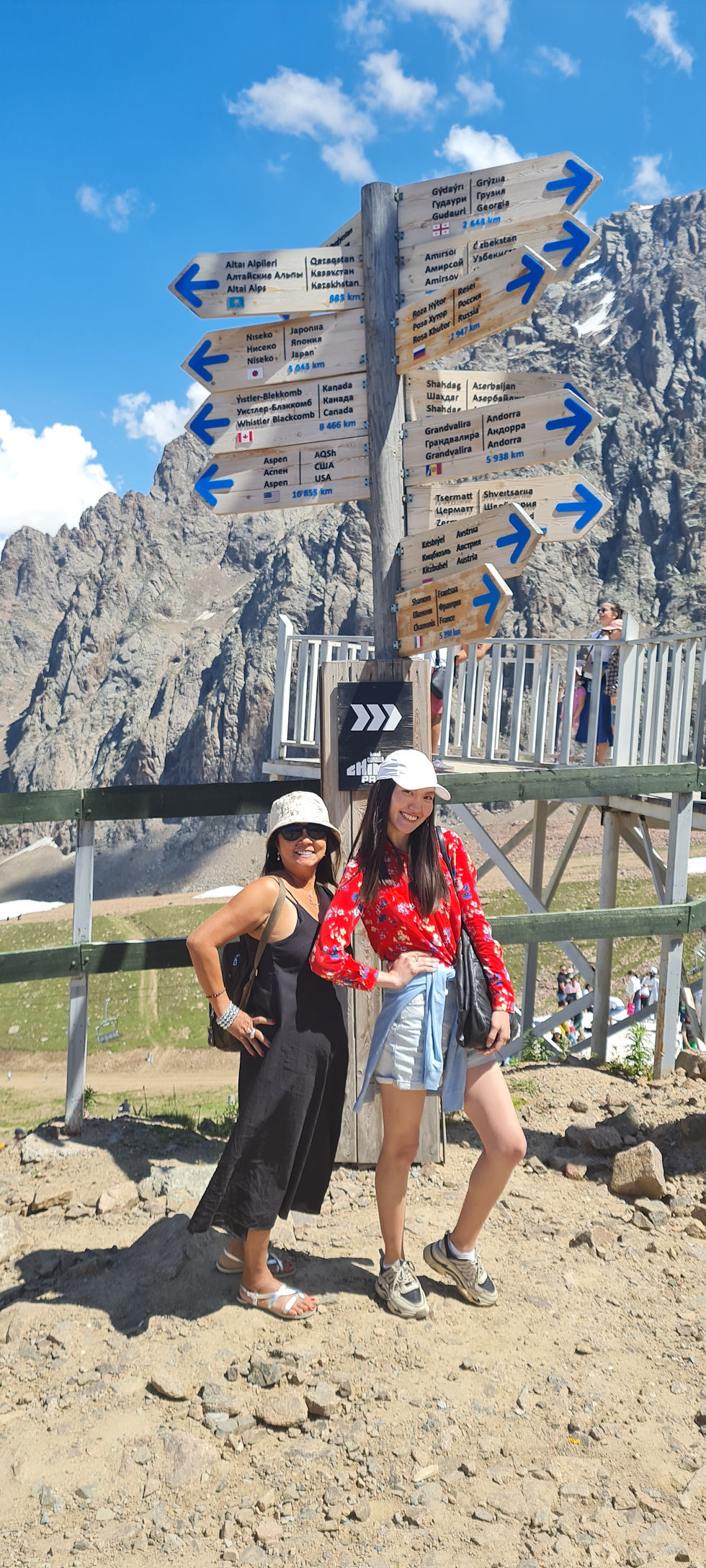
Nurdariga persuaded to take another ride, this time on a gondola to the mountain resort of Shymbulak, located in a picturesque gorge at an altitude of 2,260 meters above sea level. We took three different lifts to get us to the bar at the top where we had a cooling drink and then hiked a little to enjoy the stunning views and the fresh mountain air, far from the pollution of the city below.
In the southern part of Almaty, amid a spectacular mountain backdrop, is the First President’s Park. Opened in July 2010, it was named after the first President of Kazakhstan, Nursultan Nazarbayev. The park is the home of an annual music festival called “Almaty - my first love” and held in front of the semi-circular colonnade. The amphitheatre atmosphere is highlighted by the fountains and water features to the rear in which grateful children were bathing to cool down in the oppressive heat. Most of the tree planting is quite new, so there was little shelter against the sun when walking around the long curved pathways. Despite the superb flower beds and planting, our preference went to the more mature Panfilov Park.
A 75 minute drive from Almaty is Lake Issyk, located in a National Park. It is a fairly small but scenic mountain lake with its turquoise waters contrastng with the greenery around it and the snowy mountain peaks of Tianshan behind it. Trails led off in different directions but there is unfortunately no path around it. For a brief moment, in between the bus loads of visitors, we had it all to ourselves: perfect silence - no picnics, no frying meat, no telephones, no music, no shouts or children’s shrieks - just pure, unfiltered nature surrounding us. Surely the greatest luxury on any trip. Then it was back to the city for dinner and our final evening together with Nurdariga.
Our initial impressions of Almaty were right. It did turn out to be a beautiful city, thanks mainly to its parks and gardens everywhere as well as some stunning Soviet-modernist and Tsarist-era architecture. In addition, there were also various spectacular areas of natural beauty within easy reach. Our next destination would take us further afield for some even more stunning scenery.





Comments